
Open research: developing knowledge together
The energy transition calls for new solutions for the energy system. This is why we at Alliander conduct research into energy networks, energy technology and digitalisation, in collaboration with knowledge institutions and partners. We share the outcomes of our research through open research, so as to make knowledge accessible to all and enable others to build on our research. This will accelerate innovation and help us find solutions together sooner.
The importance
of open research
The challenges we face are as extensive as they are complex. Since we cannot tackle these challenges on our own, we have been teaming up with partners right from the start, while also validating new insights directly in our day-to-day work.
We conduct research through joint projects, but also through internships, traineeships, and PhD and postgraduate research projects. This enables us to directly match new knowledge to the challenges we face out in the field, creating value for our customers and society at an earlier stage.
Various fields
of research
Our open research is focused on topics that are essential for a future-proof energy system.
Universal access
to research and results
Alliander is committed to transparency, research & innovation, and collaboration. It is also important to Alliander to be mindful of costs and its role in society. We want this to be accessible for everyone, which is why we contribute to research and follow the open research principle to ensure universal access to research results.


Artificial intelligence
Artificial intelligence is the power tool of the energy transition. It helps us not only to work smarter and faster, but also to better utilise and design the power grid.
Show more information
While artificial intelligence is broadly embedded across Alliander, our Research Center’s AI focus is on applications that are unique to and essential for network operation. These AI applications include predicting energy supply and demand, which helps us take a smarter approach to planning the power grid and better predict usage.
Together with various universities, we are developing applications that provide insight into supply and demand and enable more efficient use of the grid.
Recent publications
- The power of assumptions: A literature review on how algorithmic design influences energy justice in electrical distribution grids
- A Review of Fairness Conceptualizations in Electrical Distribution Grid Congestion Management
- Adapting to limited grid capacity: Perceptions of injustice emerging from grid congestion in the Netherlands
- Acquiring better load estimates by combining anomaly and change point detection in power grid time-series measurements
- Preventing congestion management by modelling cable temperatures: a real-world case
- Graph Isomorphic Networks for Assessing Reliability of the Medium-Voltage Grid
- Forecasting Partial Discharges of Cable Joints using Weather data
- Creating Bottom Up Load Profiles Using Disaggregation, Clustering and Supervised Machine Learning on Large Smart Meter Dataset
- Near real-time predictions of renewable electricity production at substation level via domain adaptation zero-shot learning in sequence
- Every Ray Counts!
- Composite quantile regression with XGBoost using the novel arctan pinball loss
- Preventing Congestion in the Electricity Grid using OpenSTEF and Power Grid Model – Research portal Eindhoven University of Technology
- https://arxiv.org/abs/2510.19052
- https://arxiv.org/abs/2505.19744
- GNN deep ensembles for N-1 contingency decisions | IET Conference Proceedings
- Reactive power estimation for large-scale customers using machine learning | IET Conference Proceedings
- Grid-aware EV charging and future-proof grid design: policy decision-making by a Dutch DSO | IET Conference Proceedings
- Performance and interoperability testing of a modular merging unit and IEDs with 30 sampled value streams | IET Conference Proceedings
- Congestion management in medium voltage networks in N and N-1 situation | IET Conference Proceedings
- Probabilistic day-ahead power forecasting in the medium-voltage grid using state space models | IET Conference Proceedings
- Continuous determination of assets’ dynamic loadability by using thermal inertia and real-time conditions | IET Conference Proceedings
- Enhancing low voltage flexibility through home energy management: a co-creation approach with DSOs and market product development | IET Conference Proceedings
- Application of particle-based Bayesian inversion to underground medium voltage power cables in the Netherlands | IET Conference Proceedings
- Strongly reduced computation time of thermal modelling of primary components using a convolution-based approach | IET Conference Proceedings
- Thermo-electrical ageing of 10kV paper insulated lead covered cables: experience from field experiments | IET Conference Proceedings
- ECO-label for grid assets | IET Conference Proceedings
- Estimating cable temperature in mixed circuits with time-domain reflectometry | IET Conference Proceedings
- Overview of smart meter use cases in the Netherlands | IET Conference Proceedings
- Thermo-electrical ageing of paper insulated MVAC cables: experience from laboratory experiments | IET Conference Proceedings
- Unveiling the Dutch IEC 61850 DSO-DER realtime interface: practical insights and experiences | IET Conference Proceedings


Robotics
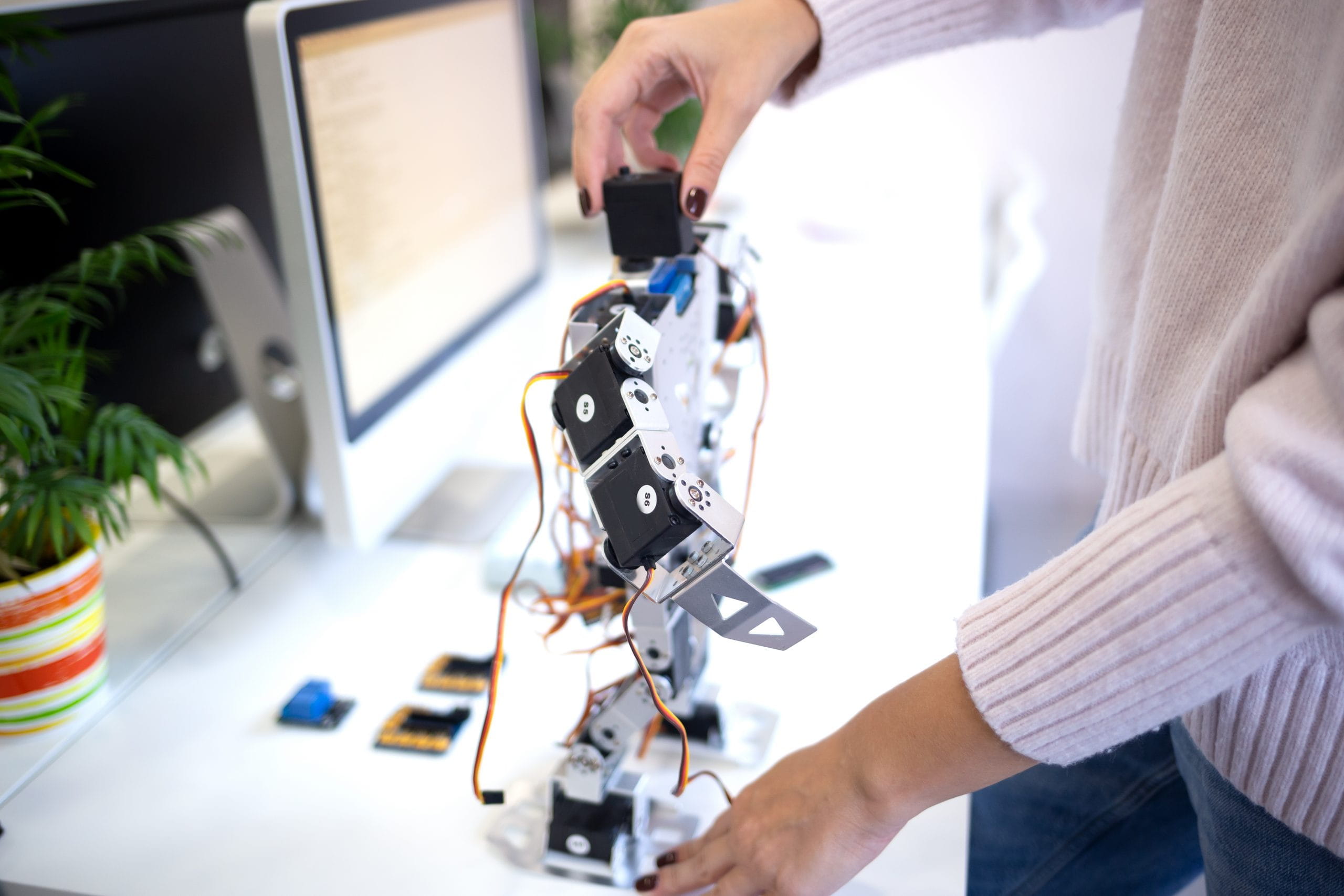
Robotics supports the physical part of our work on the construction, maintenance and safety of infrastructure. This includes automated inspections, smart tools used on building sites, and applications that make the work safer for our engineers.


Quantum technology
Quantum technologies are having a major impact. Now is the time to explore these technologies and prepare for the future. Quantum technologies offer new ways to perform complex grid calculations, for example, while also enabling us to better monitor and map out our installations and infrastructure. It also offers opportunities to make communications more secure. By exploring these technologies now, we are preparing for the future.
Show more information

This page provides a rundown of our publications and open source code in the area of quantum technologies.
Recent publications
- Quantum resource estimation for minimising energy losses, in collaboration with Capgemini Quantum Lab, Arxiv paper
- Quantum sensing with an NV magnetometer: "On cable selection and load detection", in collaboration with TNO Open-source publication
- Alliander contribution to the Quantum Guide to Commercial Acceleration: the Energy Industry, by Infinity QD (2025).
- Sparse matrix reordering with Quantum Computing for power grid calculations, in collaboration with Quantum Application Lab
- Repository QReorder (on Quantum Application Lab GitHub)
- One-pager (on Quantum Application Lab website)
- Contact us for the full report on Sparse Matrix Reordering.
- N-1 calculations with quantum annealing and gate based approach, in collaboration with Quantum Application Lab
- Neumann et al., Quantum algorithms for N-1 security in power grids (May 2024)
- Repository N minus 1 (on TNO Quantum GitHub)
- Alliander & QAL explore quantum applications
- Exploratory Quantum Technology Assessment, in collaboration with Centre for Quantum and Society and ECP (2022).


Future Insights & Experiences
In the future, the digital landscape will only become more extensive, more intelligent, and more independent. At the same time, people and devices are generating ever greater volumes of data.
Show more information
This growing complexity may cause humans to lose control of digital systems. With this in mind, we are looking for news ways for humans and digital systems to interact to ensure a digital experience of the future that is more aligned with how we humans experience the world. Our Future Insights & Experiences programme looks into how the digital experience of the future can already make a difference across today’s production and operations value chains.
Our previous publications are available on Research Gate.
Want to find out more
about open research?
Our Research Center is responsible for coordinating and facilitating an open research ecosystem. They monitor external developments and bring new technologies and fields of research to Alliander’s attention.
If you want to find out more, please contact researchcenter@alliander.com.